Knee endoprosthetics

When chronic pain and functional limitations determine everyday life and standard treatments have been exhausted, knee endoprosthetics is an established orthopaedic specialty to restore mobility with an artificial knee joint. In Prof. DDr. Faschingbauer’s knee endoprosthetics practice in Vienna, precise indication is just as important as individually tailored surgical care—aimed at restoring stability, range of motion and load-bearing capacity.

As a private doctor at the outpatient centre of Wiener Privatklinik, Prof. DDr. Martin Faschingbauer offers knee endoprosthetics at a high specialist level. His goal is to provide patients with a solid basis for deciding when surgical knee replacement is appropriate and which implant type offers the best long-term outcomes.

Knie-Endoprothetik

Overview box

Quick facts on knee endoprosthetics

  • Services: Comprehensive diagnostics, partial and total knee replacement, structured aftercare

  • Treatment location: Surgery at Wiener Privatklinik or Evangelisches Krankenhaus Wien

  • Surgery duration: approx. 60–90 minutes (depending on complexity)

  • Hospital stay: usually 3–7 days

  • Recovery: early mobilisation often possible from day 1; completion of the intensive healing phase after about 3 months

When knee endoprosthetics is indicated

Typical symptoms An artificial knee joint (knee endoprosthesis) is generally considered when joint wear has progressed to the point that quality of life declines markedly and conservative measures are no longer effective. In many cases, symptoms develop gradually over years. Typical signs include:

  • Start-up pain: stiffness and pain with the first steps in the morning or after prolonged sitting; improves after “warming up”

  • Load-related pain: especially when climbing stairs (often worse going down) or walking on uneven ground

  • Pain at rest: in advanced stages also while lying or sitting, often disturbing sleep

  • Reduced mobility: incomplete extension or flexion; activities such as putting on socks or getting into a car become difficult

  • Instability / “giving way”: feeling that the joint is no longer stable or suddenly buckles under load

  • Visible malalignment: increasing bow-leg or knock-knee due to uneven cartilage wear

  • Swelling: recurrent inflammation with warmth and swelling (“activated osteoarthritis”)

Possible causes

Usually it is not a single cause but a combination of factors over many years. The most common reason for surgery in knee endoprosthetics is advanced knee osteoarthritis (gonarthrosis), with progressive cartilage loss and increasing pain. A distinction is made between primary osteoarthritis (degenerative wear) and secondary osteoarthritis (due to underlying causes).

  • Natural wear and predisposition

  • Mechanical causes (malalignment/overload): bow-legs/knock-knees, excess weight, occupational strain (e.g., kneeling)

  • Injuries and accidents (post-traumatic osteoarthritis): ACL tears or ligament instability, meniscal damage, fractures

  • Conditions and inflammation: rheumatoid arthritis, metabolic disorders, bacterial infections, circulatory disorders

Endoprosthetics

Knee Joint

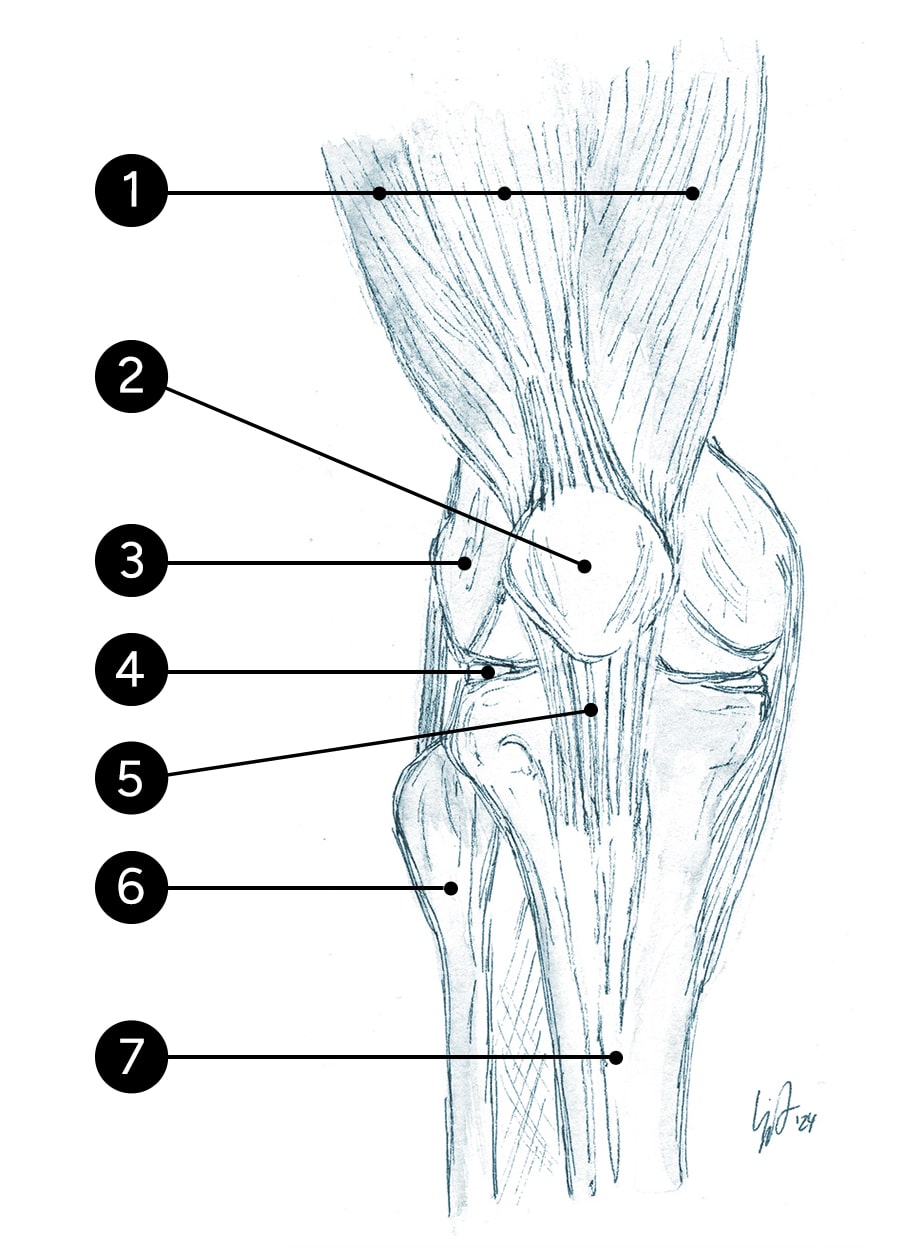
When we walk, stand, sit, or squat, we move the largest joint in the body: the knee joint.

  • 1. Thigh extensor muscles
  • 2. Kneecap (Patella)
  • 3. Thigh bone (Femur)
  • 4. Meniscus (crescent-shaped fibrocartilage)
  • 5. Patellar tendon
  • 6. Fibula
  • 7. Shinbone (Tibia)
Schematic illustration of the knee joint with labels

When you should seek medical evaluation

Orthopaedic assessment in knee endoprosthetics is advisable if knee pain persists over a longer period or if there is insufficient improvement despite conservative measures such as physiotherapy, injections/infiltrations or pain medication.

At the latest, if pain significantly limits daily life, walking distance becomes progressively shorter, or symptoms occur at rest and at night, specialist evaluation is recommended. The same applies to increasing restriction of movement, feelings of instability or visible deformity.

In Prof. DDr. Martin Faschingbauer’s knee endoprosthetics practice in Vienna, assessment follows a structured, individual approach. The focus is on differentiated diagnostics to determine the degree of joint wear precisely, assess the likely course realistically, weigh conservative and surgical options carefully, and define the optimal timing for possible knee joint replacement.

Before surgery, all suitable conservative treatment options are generally exhausted—such as physiotherapy, medication and joint-preserving therapies (addressed separately here).
Surgical treatment & procedure

If there is significant knee joint damage and symptom burden is high, a partial joint replacement may be possible in selected cases, replacing only the affected compartment(s). However, in many patients wear is already advanced at diagnosis, making total knee replacement (total knee arthroplasty / TKA, “knee TEP”) the most medically appropriate option to restore pain relief and mobility.

Quote insertion “During my clinical work, I have implanted more than 1,600 knee prostheses. Many patients prefer a partial replacement over a total knee replacement. However, this is only possible under specific conditions—such as intact ligament stability, especially the anterior cruciate ligament, and involvement of only one clearly defined compartment.”

Structured process in knee endoprosthetics:

  • Pre-operative assessment: detailed clinical examination, counselling and digital planning of the knee endoprosthesis

  • Surgery: worn cartilage surfaces are removed and replaced with a precisely fitted knee prosthesis consisting of femoral and tibial components. The implants are fixed to the bone with specialised bone cement; a highly cross-linked polyethylene insert is placed in between as the gliding surface. Ligament stability is checked and adjusted as needed. Depending on anatomy, patient-specific implants may also be used and are considered in pre-operative planning.

  • Aftercare: structured rehabilitation starts immediately after surgery with early mobilisation, targeted physiotherapy and regular medical follow-up.

In rare cases, revision surgery may become necessary after knee replacement—for example due to persistent symptoms, loosening or loss of function. In such procedures, parts of the original prosthesis or the entire implant are exchanged and replaced with specialised components. This complex revision arthroplasty requires extensive surgical experience to restore stable, pain-free function long-term.

Portrait von Prof. DDr. Martin Faschingbauer in ruhiger, professioneller Pose mit direktem Blick in die Kamera.

Patient-specific implants in knee endoprosthetics

In selected cases, patient-specific (“custom”) implants can be used. These are manufactured and planned based on detailed pre-operative imaging and tailored to the individual knee anatomy. While standard implants come in fixed sizes, a custom knee prosthesis is based on high-precision MRI or CT data. A key advantage is maximal bone preservation, as the implant matches the natural joint shape and requires less removal of healthy bone. By reconstructing your individual limb alignment and joint surfaces, the knee replacement often feels more natural in everyday life and may support a faster return to desired mobility.

Häufige Fragen zur Artificial Knee Joint

Often 20–25 years, depending on load and individual factors.
With modern anaesthesia and effective post-operative pain management, pain is usually well controlled. Some wound pain is normal initially and typically decreases quickly with appropriate medication.
Partial replacements (unicompartmental/partial joint replacement) and total knee replacements. Suitability depends on extent of wear, ligament stability and individual joint situation.
Knee prostheses vary in design, configuration and size. We use a broad portfolio of proven implant systems to ensure the best solution for each condition. All materials are developed for medical use and aim to provide durable, pain-free function.
A modern goal is the “forgotten knee”—the joint feels natural after healing due to tissue-sparing techniques and precise planning.
Often after about 6–8 weeks, provided you no longer require strong pain medication and have full control and strength for emergency braking.
[contact-form-7 id="e6d5a4a" title="Kontakt"]

Close form